
Coloring is an easy, sociable pastime to share with an older parent, grandparent or friend, whether at the kitchen table or in a care home activity room. The pages that work best are bold, clear and gentle. Here’s what to look for, how to print them, and which of ours we’d start with.
What makes a good coloring page for seniors?
A good coloring page for an older adult has thick, dark outlines that are easy to see, a small number of large spaces so the pencil doesn’t need precise control, and a clear, familiar subject such as a cat, a cottage, flowers or a teapot, with nothing busy in the background. It should be grown-up in feel rather than a children’s cartoon, so it doesn’t seem patronising, and calm rather than exciting. Printed full size on a sheet of slightly heavier paper, with nothing on the back, it lies flat and survives a firm hand.


Which of our books to start with
Start with Quiet Corners, our easiest collection. It was drawn with exactly this in mind: thick outlines, one big subject per page and nothing fiddly, on familiar, comforting subjects. Sleepy Pets & Pals, Comfort Food & Sweet Treats and Simple Houseplants & Succulents are the simplest; Gentle Ocean Scenes & Seashells and Relaxing Reading Nooks add a few fuller scenes for a longer sit. All of them are on our bold and easy coloring pages page.
The Quiet Corners Collection
Ten bold and easy books, 50 pages each, from $6.99. A trio is $16.99.
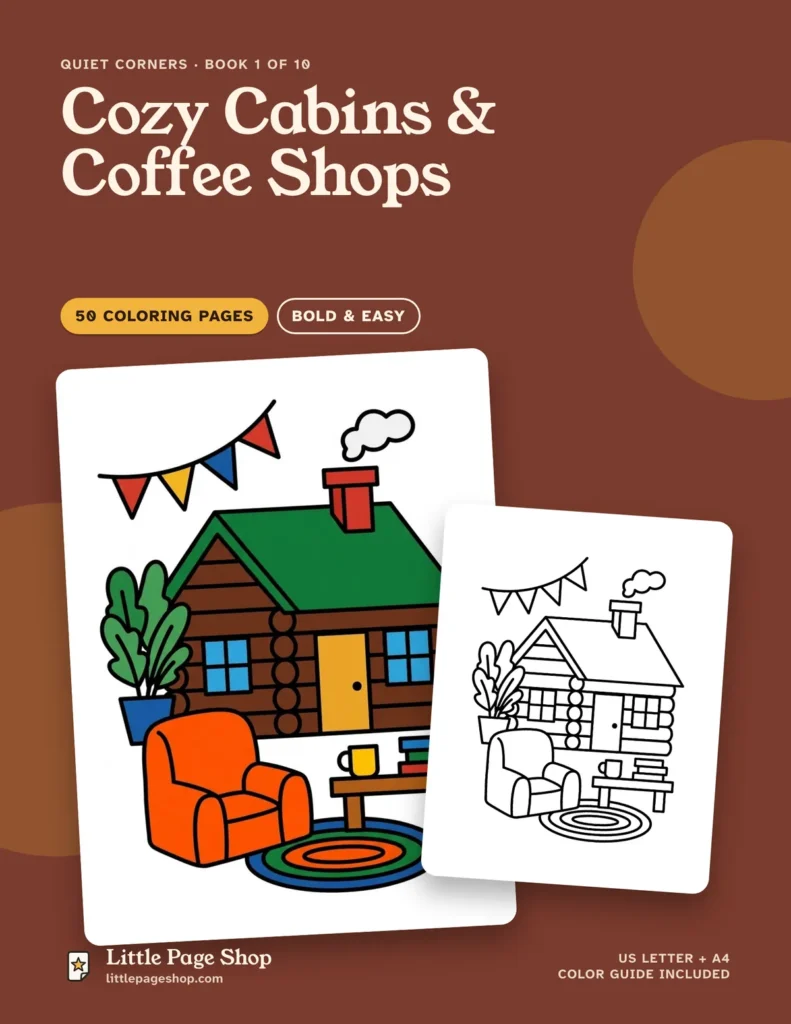


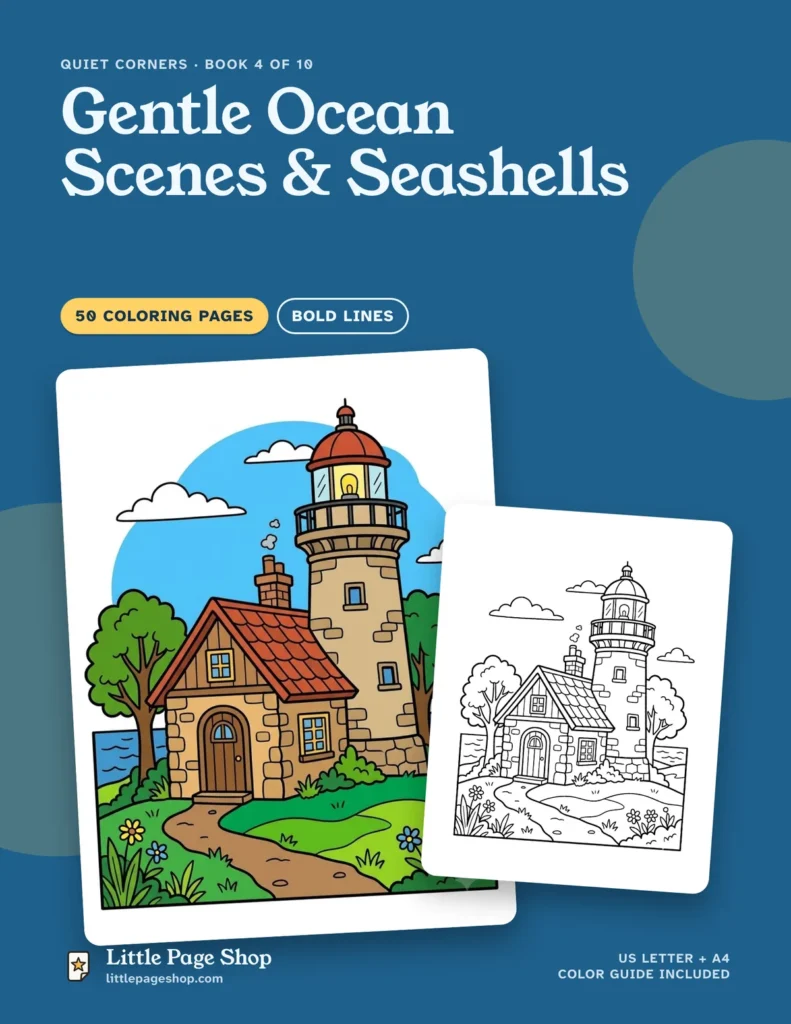

Our Cozy Cottage books are the next step. They have bold outlines, rounded shapes and big spaces, and gentle subjects that often spark a conversation: a cat in a window box, bread and jam, a flower border, a tea table. Cozy Cottage Cats and Cozy Cottage Kitchen are the simplest; Cozy Cottage Garden and Cozy Cottage Tea Party suit keen gardeners and tea drinkers. The finer Honeywick books are better kept for experienced colorists with good eyesight and a steady hand. Our guide to easy vs detailed coloring pages compares the two.
How to print them
- Print at full size. Set the scale to 100% or “Actual size” so the lines stay as bold as they’re drawn. Use the file that matches your paper, US Letter or A4.
- Use heavier paper. 100–120 gsm (28–32 lb) doesn’t crease or tear under a firm pencil, and cardstock is better still for felt-tip markers.
- Print a few pages at a time. A choice of three is easier than a whole book, and you can print a favorite again as often as you like.
- Clip it to a board. A clipboard keeps the page still for anyone coloring one-handed or on their lap.
Every setting is in our printing guide.
Tools that are easy to hold
Chunky or triangular colored pencils, soft-core pencils that give strong color without pressing hard, and felt-tip markers with a broad tip are all kind to stiff fingers. Foam pencil grips from a stationery shop help too. Avoid very hard pencils, which need a lot of pressure, and fine-tip pens, which suit detailed pages rather than bold ones. There’s more in our guide to pencils and markers for coloring pages.
Can I print them for my parent’s care home?
Printing pages for your own family, including a parent in care, is covered by our personal-use license. If you run activities for a care home or a group, email littlepageshop@leafyorb.com and we’ll sort out a license for your setting. Try the free Cozy Cottage sampler first to see whether the style suits.
Common questions
Many are, but look for bold outlines and large spaces. Very intricate adult designs can be frustrating if eyesight or grip isn’t what it was.
The pages are drawn to fill a US Letter or A4 sheet. For something larger, a print shop can print a page on A3 or tabloid paper; ask them to scale it to fit that sheet.
100–120 gsm (28–32 lb) paper is sturdy enough for firm pencil pressure. For felt-tip markers, use 160 gsm (65 lb) or cardstock so the ink doesn’t soak through.